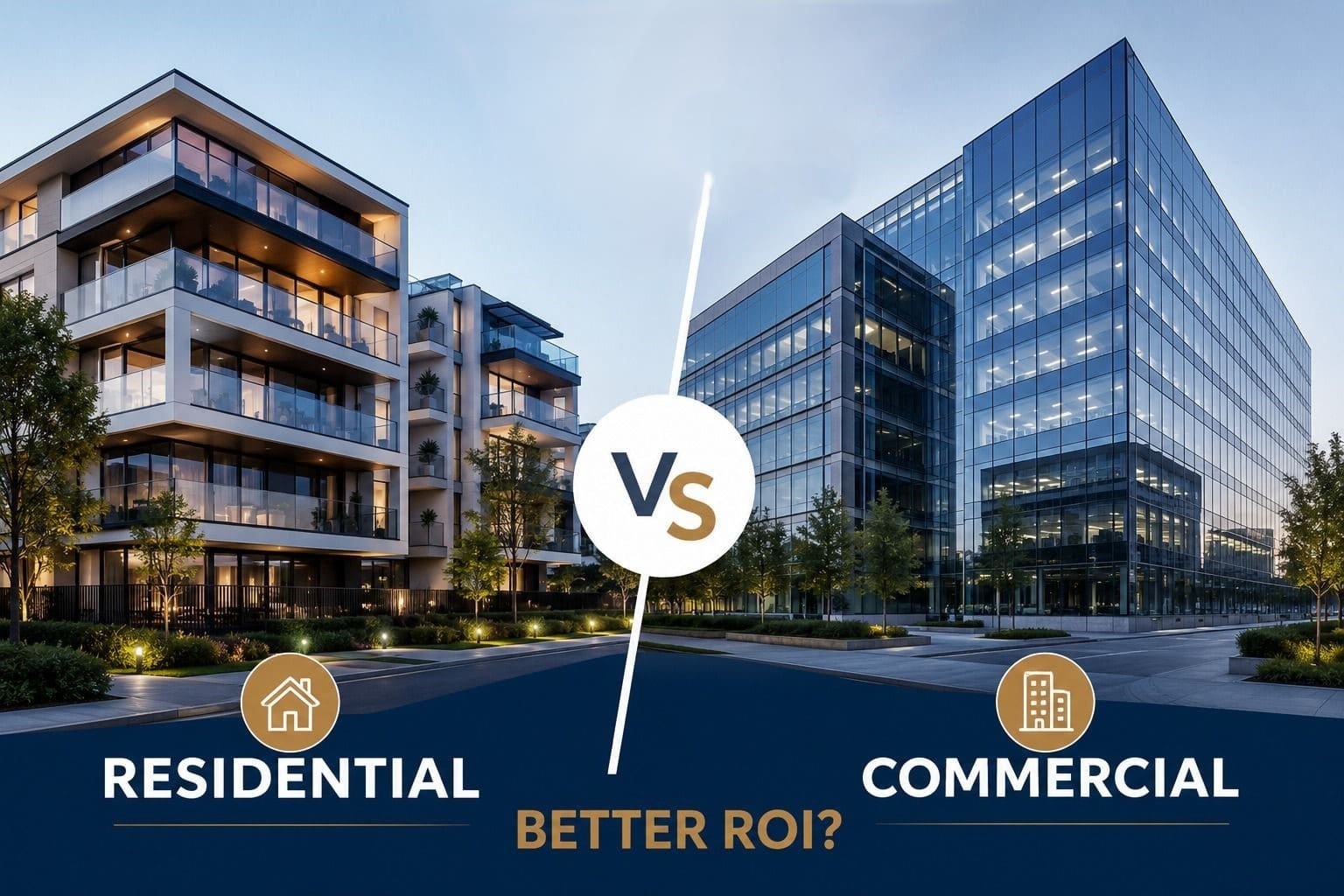
When it comes to building generational wealth, real estate remains the undisputed heavyweight champion of the investment world. But as we navigate the economic landscape of 2026, the age-old dilemma continues to puzzle both seasoned high-net-worth individuals (HNIs) and first-time buyers alike: Should you invest in residential or commercial property? To evaluate the Residential vs Commercial Property ROI landscape, we must analyze the ultimate metric that dictates the success of any real estate venture.
However, a "good return" is no longer just about calculating monthly rent or waiting blindly for property prices to skyrocket. In today's mature market—especially within fast-evolving economic powerhouses like Delhi NCR and Gurgaon—the dynamics of capital appreciation, tenant profiles, and operational costs have completely transformed.
Choosing the wrong asset class can lock up your hard-earned capital in a low-yielding, illiquid investment. Conversely, a strategic choice aligned with your financial goals can create a predictable cash flow engine and an ever-growing safety net. This comprehensive 2026 investment guide breaks down the structural differences, risk profiles, and real-world returns of residential versus commercial properties to help you make an informed, highly profitable decision. If you want to review general topics first, you can read our Krishna Realty Insights Blog.
What is Residential Property?
A residential property is any real estate structure designed exclusively for living purposes. These properties cater to individual housing demands, ranging from single families to groups of working professionals looking for a place to call home.
- Studio Apartments & 1 BHKs: Popular among young working professionals and students in dense urban clusters.
- Luxury 3 BHK & 4 BHK Apartments: Gated communities featuring clubhouses, premium security, and dedicated lifestyle amenities, which are currently dominating the premium corridors of Gurgaon.
- Independent Floors: Multi-story residential layouts where each floor is owned individually, combining private living with community benefits.
- Villas & Penthouses: High-ticket, ultra-luxury assets targeted at HNIs and top-tier corporate executives.
What is Commercial Property?
A commercial property refers to any real estate asset used exclusively for business-related purposes or to provide a workspace rather than a living space. These properties are leased to corporate entities, retail business owners, or institutional tenants.
- Grade-A Office Spaces: High-end floors or entire buildings leased to MNCs, tech companies, and Global Capability Centres (GCCs).
- Retail Shops & High-Street Showrooms: Ground-floor commercial spaces located in highly foot-trafficked retail developments or malls.
- Shop-Cum-Office (SCO) Plots: A highly versatile hybrid model booming across Delhi NCR, allowing investors to build retail shops on the lower floors and offices on the upper floors.
- Warehouses & Industrial Logistics Hubs: Large-scale storage facilities located on the periphery of major expressways, driven heavily by quick-commerce and e-commerce expansion.
Understanding ROI in Real Estate
Real estate ROI is not a single number; it is a combination of regular inflows and long-term valuation growth.
The Real Estate ROI Formula
Total ROI = [ (Annual Net Rental Income + Annual Capital Appreciation) / Total Investment Cost ] × 100
Total Investment Cost includes purchase price, stamp duty, registration charges, brokerage, and immediate renovation costs.
Rental Yield: Rental yield measures the annual rental income generated by an asset as a percentage of its total cost.
Gross Rental Yield = (Gross Annual Rent / Property Purchase Price) × 100
Capital Appreciation: Capital appreciation is the increase in the market value of your investment property over time. It is driven by macro-economic factors, infrastructural growth, inflation, and localized demand-supply mismatches.
Cash Flow: Cash flow represents the actual money moving into and out of your bank account every month. A positive cash flow means your rental income easily covers your monthly loan EMIs, property taxes, and maintenance fees.
Residential Property ROI: Deconstructed
ADVANTAGES High liquidity, easier bank financing, strong emotional stability.
DISADVANTAGES Low rental yields, higher maintenance and tenant turnover.
Commercial Property ROI: Deconstructed
Tenant Pays: Base Monthly Rent, Common Area Maintenance (CAM), Local Property Taxes, and Building Insurance Premium.
Result: Predictable, Hands-Free Cash Flow
ADVANTAGES Industry-leading rental yields, long-term lease terms, NNN structure.
DISADVANTAGES High capital entry barriers, prolonged vacancy risk.
Residential vs Commercial Property Comparison
| Feature / Metric | Residential Property | Commercial Property |
|---|---|---|
| Average Rental Yield | 2.5% – 4.5% per annum | 7.0% – 10.5% per annum |
| Capital Appreciation | Higher in emerging corridors | Highly tied to business performance & location |
| Initial Capital Required | Moderate (₹50 Lakhs to ₹3 Crores) | High (₹2 Crores to ₹15+ Crores) |
| Loan Availability | Easy; up to 80% financing; lower rates | Stricter criteria; commercial rates are higher |
| Lease Term / Horizon | Short-term (11 to 24 months) | Long-term (5 to 9+ year institutional leases) |
| Vacancy Risk | Low; easily rentable in 30-60 days | High; vacancies can stretch from 6 to 12 months |
| Maintenance Burden | Landlord covers major upkeep | Tenant handles fit-outs & maintenance |
| Liquidity Level | Relatively High; massive resale pool | Moderate to Low; yield dependent |
| Tax Benefits | Sections 24(b) and 80C for loans | Deductions limited mostly to standard 30% |
| Ideal Investor | First-time buyers, defensive portfolios | HNIs, yield-seekers |
Rental Yield Comparison: Residential vs Commercial
Imagine you have a capital pool of ₹2 Crores to deploy into the Gurgaon market:
Scenario A: The Residential Path
Purchase a premium 3 BHK apartment for ₹2 Crores.
- Monthly Rent: ₹55,000
- Annual Gross Rent: ₹6.6 Lakhs
- Gross Rental Yield: 3.3%
- Net Yield after maintenance/brokerage: ~3.0%
Scenario B: The Commercial Path
Purchase Grade-A pre-leased office space for ₹2 Crores.
- Monthly Rent: ₹1,40,000
- Annual Gross Rent: ₹16.8 Lakhs
- Gross Rental Yield: 8.4%
- Net Yield (tenant pays maintenance): ~8.0%
The Yield Verdict: For every rupee spent, commercial property delivers nearly 2.5 to 3 times more monthly rental income than residential options.
Expert Tips Before Investing
- Always Verify RERA Registration (HRERA).
- Analyze the Location's Infrastructure Timeline.
- Evaluate the Developer’s Execution History.
- Prioritize Pre-Leased Commercial Assets.
- Check the Lock-In Period Clauses in contracts.
- Assess the Loading Factor in Commercial Spaces.
- Opt for Low-Density Layouts in Residential.
Ready to Secure High-ROI Real Estate?
As the Delhi NCR and Gurgaon real estate markets mature through 2026, success comes down to choosing the right micro-market and doing thorough due diligence. Partner with Krishna Realty to navigate these options with verified data-backed insights.
Contact our expert advisory team today at consultation@krishnarealty.in or visit our Insights Homepage.






No comments yet. Be the first to share your thoughts!